

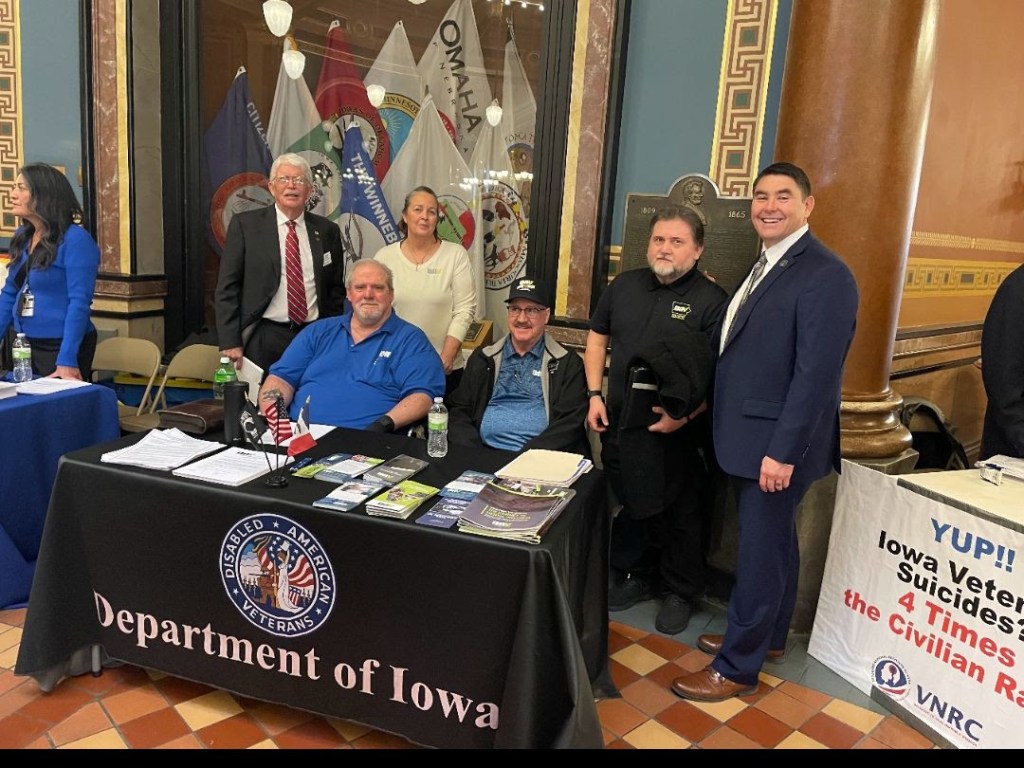
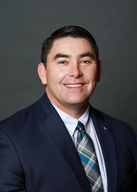
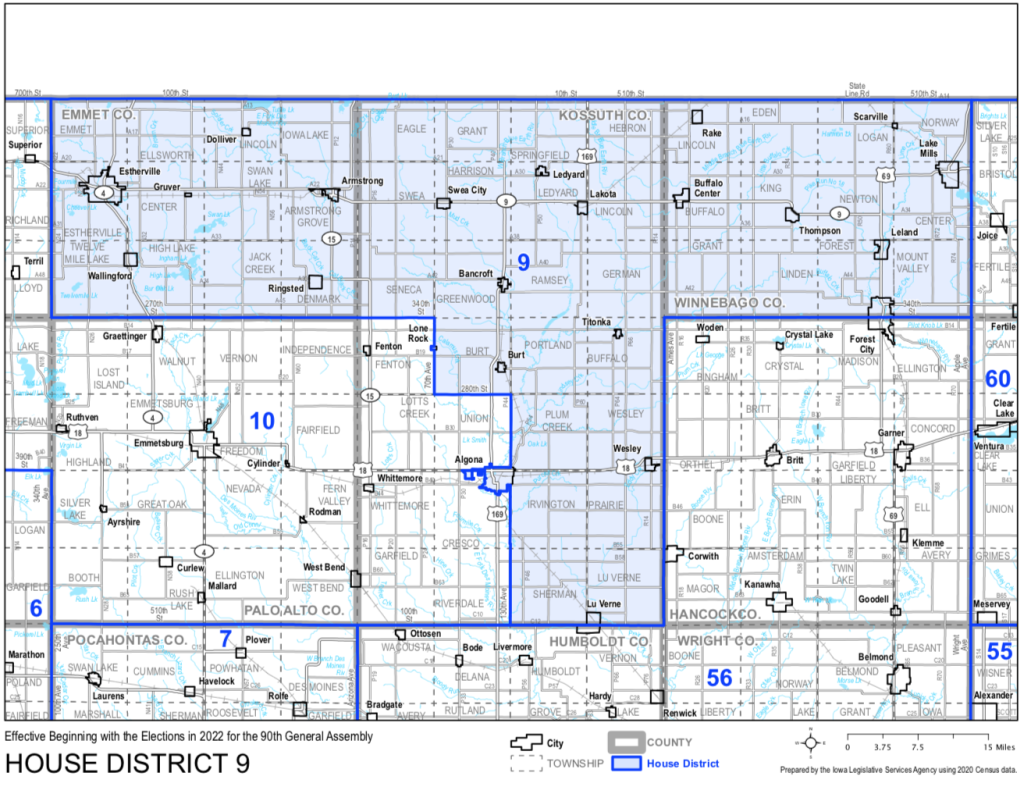
The following is a legislative update from Republican Representative Henry Stone of Forest City, representing portions of Emmet, Kossuth and Winnebago counties in Iowa House District 9:
“Nation’s Report Card” Shows Encouraging Progress in Literacy, Underscores Iowa’s Need for Evidence-Based Mathematics Support
The 2024 National Assessment of Educational Progress (NAEP) results released by the U.S. Department of Education show encouraging gains with Iowa in the top 10 of all states for eighth grade reading scores, as Iowa continues to invest in proven practices grounded in an evidence-based approach known as the “Science of Reading.”
Mathematics scores for both fourth and eighth graders decreased by 3 points and 2 points, respectively, while Iowa’s math rankings fell significantly to 30th and 23rd in the nation. The significant drop in Iowa’s latest mathematics rankings is in part driven by other states rebounding from their lower 2022 scores while Iowa ensured consistent access to in-person instruction throughout the 2020-21 and 2021-22 school years. However, Iowa’s mathematics results underscore the need for statewide investment in evidence-based mathematics instruction.
“As we continue to build upon Iowa’s comprehensive investments in evidence-based reading instruction, we celebrate the hard work of students, families, and educators that resulted in Iowa’s top 10 national ranking in eighth grade reading,” said Iowa Department of Education Director McKenzie Snow. “At the same time, Iowa’s concerning mathematics rankings underscore the critical need to support evidence-based mathematics instruction statewide, as proposed by Governor Reynolds and the Department in the Math Counts Act. Iowa’s students with disabilities and students who are English learners also experienced some of the largest achievement gaps in the nation. Together with educators and families, Iowa will continue to invest in instruction and interventions that empower all students to meet high expectations and realize their incredible potential.”
Commonly referred to as “The Nation’s Report Card,” NAEP is congressionally mandated to be administered every two years to students in grades 4 and 8 to measure achievement in reading and math. NAEP is the only nationally representative assessment allowing for comparison of student achievement across all 50 states using a robust sampling methodology.
National average scores for public school students across all tested grades and content areas show the nation as a whole has not returned to pre-pandemic achievement levels. Nationally, mathematics scores fell by 3 points for fourth grade and 9 points for eighth grade. National reading scores in both fourth and eighth grade fell 5 points from 2019 scores.
Iowa’s NAEP data demonstrate significant achievement gaps between overall student results and those of certain student groups. Reading and mathematics rankings comparing the achievement of Iowa’s students with disabilities to students with disabilities across the nation show Iowa has some of the largest achievement gaps nationwide. While Iowa ranked 10th in eighth grade reading, Iowa ranked 41st in the achievement of students with disabilities. NAEP achievement is also used in the U.S. Department of Education’s designations for state special education systems under the Individuals with Disabilities Education Act (IDEA).
Rankings comparing the achievement of students who are English learners to students who are English learners across the nation also demonstrate significant achievement gaps. While Iowa ranked 23rd in eighth grade math, Iowa ranked 37th in the nation in the achievement of students who are English learners.
NAEP is overseen and administered by the National Center for Education Statistics (NCES) within the U.S. Department of Education and the Institute of Education Sciences. More information on the 2024 NAEP results is available on the Nation’s Report Card website at https://www.nationsreportcard.gov/
Judiciary Committee Works on Bills to Protect Minors
The House Judiciary Committee has begun work on multiple bills to protect children from obscene material both online and in person. These bills focus on the online world of pornography, AI created images, and strong penalties for those who prey on children.
House File 62 establishes liability for a commercial entity that publishes or distributes pornography on the internet, if a minor gets access to the material and House File 64 increases the penalties for individuals who knowingly share or display obscene material to minors, excluding parents or guardians.
HF 62 is not intended to target internet providers but instead, it’s focused on the websites and companies that produce and distribute the pornographic materials. As of now, 19 states have laws requiring some type of age verification before an individual can view a pornographic site. The language of the bill is being carefully evaluated and will be up for a vote in the Judiciary Committee in the next several weeks.
HF 62 also tackles artificially created pornography. Under current law, pornography featuring someone under the age of 18 is already illegal. But what if the person portrayed wasn’t a real person? HF 62 makes it a crime to use AI to create a child and use that child in a pornographic way. This prevents pornographic companies from trying to avoid the law on child pornography by “creating” the image of a fake child and using the image in obscene ways. Representatives are currenting working on the language of the bill to prevent loopholes as technology advances.
I am proud to personally floor manage HF 64. Currently this crime is classified only as a serious misdemeanor, but this bill would increase the penalties, in a tiered fashion, from a serious misdemeanor for the first offense to an aggravated misdemeanor for the second offense to a class “D” felony for the third and subsequent offense. A serious misdemeanor carries a potential sentence of one year in jail. An aggravated misdemeanor carries a potential sentence of two years in prison and a class “D” felony carries a potential prison sentence of up to five years and requires offenders to register as sex offenders for ten years. In addition to increasing the penalties for these offenses, I also added mandatory minimum sentences to both the aggravated misdemeanor and felony charges.
House Introduces Legislation to Curb Pharmacy Benefit Managers Harmful Practices
This week, the House Commerce Committee introduced House Study Bill 99, a bill to address harmful practices that Pharmacy Benefit Managers (PBMs) have put in place impacting Iowans and pharmacies. PBMs are the entity between health insurers and drug manufacturers, who process prescription medication claims on behalf of the insurer or employer.
This bill includes the following additional regulations of PBMs in Iowa:
· Prohibits a PBM or insurer from discriminating against a pharmacy if the pharmacy is acting within its license and all laws
· Prohibits the removal of pharmacy choice or imposing any monetary advantages or penalties that result in removing pharmacy choice (including unnecessary specialty drug designations and requiring use of mail order pharmacies)
· Prohibits additional cost-sharing on the insured based on where they choose to have their prescription filled
· Requires all rebates to benefit the insured
· Requires any amount paid by the insured for the prescription drug to be applied to their deductible
· Requires PBMs to reimburse pharmacies based on acquisition cost
· Prohibits spread pricing unless all cost differential is provided to the insured
· Requires pharmacies have an appeals process if not reimbursed at acquisition cost
In 2022, the legislature brought PBM oversight under the Iowa Insurance Division. The division will be releasing their investigation into Iowa’s PBMs this spring after 2.5 years of scrutiny.
These bills support Iowa’s pharmacies. 29 pharmacies closed in 2024, which is a 52% increase from 2024. More than 150 pharmacies have closed over the past decade, impacting Iowans access to care.
2 thoughts on “Rep. Henry Stone of Forest City says bill aims to punish “commercial entities” that display obscene material to minors”
You are a fraud. How do private school students fare when the NAEP looks at them? Oh, that is right, you guys exempted private schools from having any oversight.
jealous are we?