



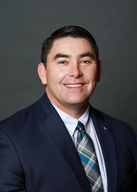
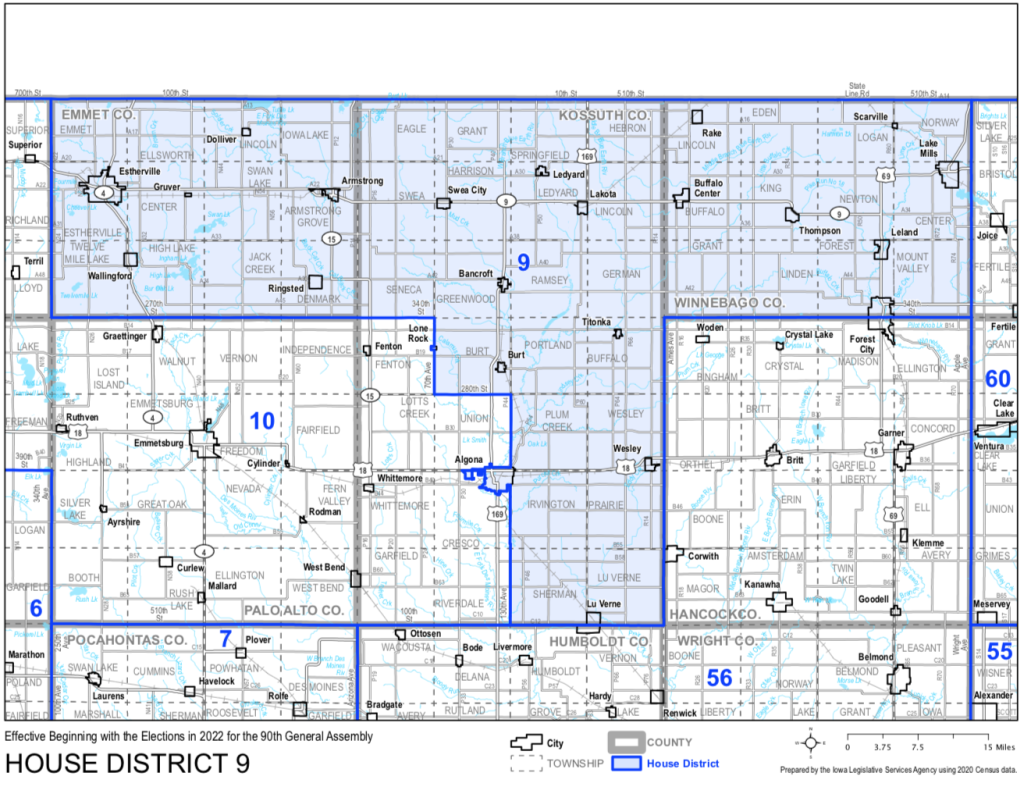
The following is a legislative update from Republican Representative Henry Stone of Forest City, representing portions of Emmet, Kossuth and Winnebago counties in Iowa House District 9:
SSA Final Agreement
This week, we passed a final SSA agreement, SF 167, after months of negotiations. While our original proposal included more money for schools, this final agreement includes a couple of key wins secured by Iowa House Republicans.
The agreement includes:
– The increase in SSA for Fiscal Year 2026 plus an additional $5 per student. This results in more than $105,000,000 more in school aid.
– This year also brings phase two of the teacher salary increase. This will include almost $35,000,000 additional dollars for public schools.
– The State Cost Per Pupil amount increases to $7,988 per student which includes an additional $5 for per pupil equity, which was a key component fought for by House Republicans. This is an increase of $162 per pupil.
– The operational sharing cap increases from 21 to 25, an additional $942,087 for public schools.
– There is an additional increase in transportation equity, which brings an additional to $1,554,938 more for public schools.
It also extends the Property Tax Relief Payment (PTRP) an additional year which has the state pick up any property tax growth in the Additional Levy portion of the school funding formula. The amount that the State picks up will now be over $136,000,000.
House Republicans secured more than $4.7 million in additional investments for public schools through our negotiations. These increases represent many of the specific funding issues we hear from our school districts. While each line item may not affect each individual school district equally, one line item may have a big impact on addressing the issue a specific district is facing. House Republicans are working to respond to the specific concerns we’re hearing from our schools in a responsible manner.
Democrats’ False Claims on School Funding
Democrats repeated the grossly misleading claim that we are increasing ESA funding by 44% while increasing public school funding by 2%. They say this to make it sound as if we are spending more on private schools than on public schools, but that is far from the truth. The cost per pupil of ESAs increases each year at the same rate as the number we set for SSA. This year is the final year of expansion in the ESA program that allows all families to qualify. This is why the increase looks greater this year, not because more was given to private schools.
Does the state spend more on ESA’s than on public K-12 schools? Here’s a chart to show the amounts spent:

What Kind of Accountability Exists in the ESA Program?
The Iowa Education Savings Account (ESA) program, established under the Students First Act, includes several safeguards and accountability measures to prevent improper expenditures by recipients and schools. These measures ensure that funds are used appropriately for approved educational purposes while maintaining oversight and transparency. Below are the key safeguards and accountability mechanisms in place:
Administration by a Third-Party Entity:
The Iowa Department of Education has contracted with Odyssey, a third-party administrator, to manage the ESA program. Odyssey handles applications, financial transactions, compliance, and fraud prevention. This external oversight helps ensure that funds are securely administered and that payments are processed only for verified, eligible expenses.
Restricted Use of Funds:
ESA funds must first be used to pay tuition and fees at an accredited nonpublic school before any remaining balance can be applied to other qualified educational expenses, such as textbooks, tutoring, or educational therapies. This prioritization ensures that the primary purpose—supporting enrollment in accredited schools—is met before discretionary spending is allowed.
Approval and Verification Process:
Parents or guardians must apply annually for an ESA, and applications are subject to verification processes. For example, residency and income (where applicable) are checked, often through automated systems like Iowa state tax return data. Once approved, families must designate the accredited nonpublic school their child will attend, and the school invoices the ESA account directly. Payments are only released after parental approval, keeping funds under state control until a legitimate expense is confirmed.
Enrollment and Payment Deadlines:
To retain ESA funds, students must be enrolled in an accredited nonpublic school, and tuition and fees must be paid through the ESA portal by specific deadlines (e.g., September 30 for fall funds and February 1 for spring funds in the 2025-26 school year). If these conditions aren’t met, the student becomes ineligible, and the account is closed, with any remaining funds returned to the state’s general fund. This ensures funds are tied to active participation in an accredited educational setting.
Fraud Detection and Penalties:
The program includes provisions to address fraudulent use of funds. If funds are improperly obtained or spent, the Department of Education or Odyssey can recover those amounts from the parent or guardian, including through legal action if necessary. Parents or guardians found to have committed fraud are barred from future participation in the program, serving as a deterrent against misuse.
Closure of Unused Accounts:
When a student graduates high school or turns 20 (whichever comes first), any remaining funds in their ESA account are transferred back to the state’s general fund. This prevents indefinite retention of unused public money and ensures it is redirected to other state priorities.
Accreditation Requirement for Schools:
Only accredited nonpublic schools can participate in the ESA program. This requirement ensures that schools meet certain educational standards, providing a baseline of accountability for the institutions receiving ESA funds. Home-based education and unaccredited programs are explicitly excluded from eligibility.
Annual Application Requirement:
Families must reapply each year to continue participating, which allows the state to reassess eligibility and monitor ongoing compliance. This recurring process helps prevent long-term misuse by requiring regular updates and verification.
What are the qualified educational expenses?
Tuition and Fees at an Accredited Nonpublic School:
This is the mandatory first use of ESA funds. It includes costs associated with enrolling a student in an accredited private school in Iowa, such as tuition, registration fees, or other mandatory school fees.
Textbooks:
Funds can cover the cost of textbooks required for coursework or related to the student’s education, whether purchased new, used, or rented.
Tutoring Services:
Payments for one-on-one or small-group tutoring are allowed, provided the tutor is a licensed educator or a professional qualified to offer academic support.
Educational Software or Online Learning Programs:
Expenses for software, apps, or online courses that supplement the student’s education, such as math or language learning platforms, are permitted.
Curriculum Materials:
Costs for curricula or instructional materials directly tied to the student’s educational needs, such as workbooks or lesson plans, qualify.
Fees for Standardized Tests:
This includes fees for national or state-recognized assessments (e.g., ACT, SAT, Iowa Assessments) that measure academic progress or are required for college admission.
Educational Therapies:
Services like speech therapy, occupational therapy, or other specialized interventions are covered if provided by a licensed practitioner and deemed necessary for the student’s educational progress.
Transportation Services:
Limited to transportation provided by a school or a contracted service to get the student to and from the accredited nonpublic school. This does not include personal vehicle expenses or reimbursements for parental driving.
Fees for Extracurricular Activities:
Costs for school-sponsored extracurriculars (e.g., sports, music, or clubs) may qualify if they are offered through the accredited nonpublic school and tied to the student’s enrollment.
Other Approved Expenses:
The Iowa Department of Education may specify additional allowable expenses through administrative rules, but these must align with the program’s educational focus. For example, certain supplies or equipment directly tied to coursework (like lab materials) might be included.
Key Restrictions:
Funds cannot be used for general living expenses, entertainment, or non-educational items (e.g., toys, electronics not tied to coursework).
Expenses must be verified and approved through the ESA portal managed by Odyssey, the third-party administrator, ensuring that only legitimate educational costs are reimbursed or paid.
Home-schooling expenses or costs associated with unaccredited programs are explicitly excluded, as the program is tied to enrollment in accredited nonpublic schools.
Parents access these funds via a digital wallet in the Odyssey platform, where they submit and approve expenses, adding a layer of oversight to prevent misuse.
Is the ESA program audited?
The Iowa Department of Education, which oversees the ESA program, is responsible for ensuring compliance with the Students First Act. As a state agency managing public funds, it is subject to audits by the Iowa State Auditor’s Office. The State Auditor has the authority to examine state programs, including the ESA, to verify that funds are being spent appropriately and in accordance with Iowa law.
Odyssey handles day-to-day operations, including processing payments, verifying expenses, and monitoring for fraud. As part of its contract, Odyssey is required to maintain auditable records of all transactions and compliance activities. The Department of Education has the authority to audit Odyssey’s performance to ensure it adheres to state guidelines, such as approving only qualified educational expenses and safeguarding against improper expenditures.
These measures balance flexibility for families with oversight to protect public funds. The use of a third-party administrator, strict eligibility and expenditure rules, and mechanisms for recovery and penalties create a framework intended to minimize improper use by both recipients and schools.
House Republicans Strengthen Election Integrity
This week the Senate passed HF 954 which addresses the issue of citizenship verification for voters and protects the constitutional requirement that only US citizens participate in US elections. Division IX of the bill strengthens citizenship verification and helps ensure that the Secretary of State and county auditors in Iowa are not solely reliant on the federal government to confirm a potential voter’s citizenship status.
The law now provides tools and policies to catch noncitizens within days of registering to vote. A status code for voter registration records, designated as “unconfirmed”, will ensure that ballots are not given to any potential voters whose citizenship status has yet to be confirmed or has informed the DOT or other state agencies that they are not US citizens. To bolster the unconfirmed status, the bill codifies and directs the sharing of information between state agencies and other states to ensure the most up to date information of potential individuals who have indicated to a state agency that they are not citizens. The bill also expands reasons to cancel a voter’s registration to include citizenship status and allows challenges of voter’s qualifications to include questioning citizenship status.
Now having passed both chambers of the legislature, HF 954 will be sent to the Governor’s desk for consideration to be signed into law.
DOT Warns Iowans About Phishing Scam
The Iowa Department of Transportation is warning consumers of a recent text phishing scam that is occurring across the country. Citizens are receiving fraudulent text messages that appear to be from the Iowa DOT that say they have an unpaid toll or registration fee. The text asks recipients to click on a link to provide personal information as well as credit card numbers. Many times, the link will lead to a website that looks like the Iowa DOT’s website.
These texts are not from the Iowa DOT and citizens SHOULD NOT click on links within the text messages or provide personal details.
The Iowa DOT does not send out fee collection reminders via text. Any payment requests from the DOT are made through personal transaction, via physical mail, or through an online transaction initiated by the customer. In addition, the Iowa DOT does not collect tolls on any of their roads or bridges.
If you receive a phishing text:
– Don’t click on any links in, or respond to, unexpected texts. Scammers want you to react quickly, but it’s best to stop and check it out.
– Check to see if the text is legit. Reach out to the state’s tolling agency using a phone number or website you know is real — not the info from the text. Government websites in Iowa, including the DOT end with “.gov”
– Report and delete unwanted text messages. Use your phone’s “report junk” option to report unwanted texts to your messaging app or forward them to 7726 (SPAM). Once you’ve checked it out and reported it, delete the text.
If you feel that you are a victim of a text scam:
– Consider filing a police report with the local law enforcement agency where you reside.
– Report internet-based crime: ic3.gov
– Speak to AARP’s Fraud Watch Helpline and find Fraud Victim Support Groups (all ages accepted)
– Request a free credit report and research identity theft prevention: https://www.annualcreditreport.com/index.action
4 thoughts on “Rep. Henry Stone declares that rate of funding increase for private school vouchers will match that for public shools”
This Stone guy is as dumb as dirt. The diploma he has was bought for him by wealthy Republicans who wanted a stupid guy they could run in an unopposed district. They recruited this failed used-car salesman, dusted him off, bought him a couple of nice suits, bought him a somewhat better haircut, bought him a diploma or two, and voila! A Repub representative!
Sounds like a Kamala recipe
No, it sounds like you – a middle manager wannabe who has never done much good in his life.
If private schools want tax money to run their schools then they should be subjected to the same rules and oversight public schools are required to follow.