



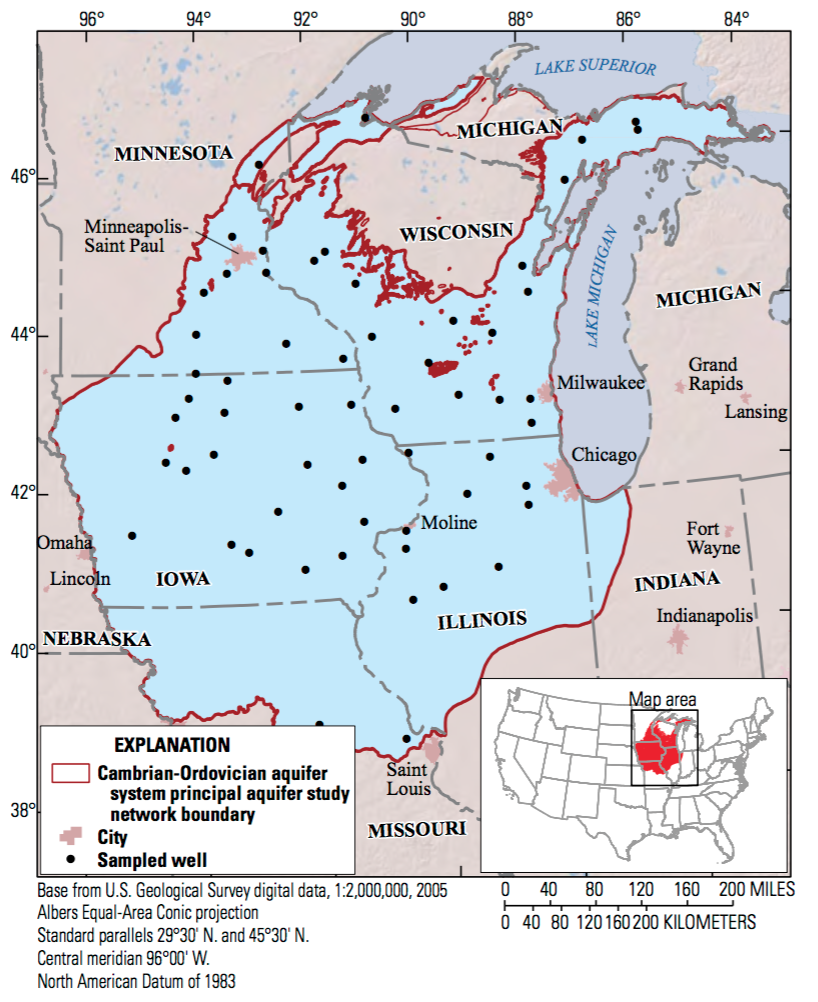
 DES MOINES- A regional assessment of untreated groundwater in the Cambrian-Ordovician aquifer system, which serves parts of several midwestern states and Iowa (including Mason City), shows radioactive constituents present in up to 45% of samples.
The Cambrian-Ordovician aquifer system ranks ninth in the nation as a source of groundwater for public supply, providing 631 million gallons per day for this use. The aquifer underlies an area with a population of about 26 million people in parts of seven states and includes the metropolitan areas of Chicago, Illinois; Milwaukee, Wisconsin; and Minneapolis-St. Paul, Minnesota, as well as parts of Iowa including Mason City.
Documents from City Hall in Mason City say the city water supply obtains its water from the sandstone and dolomite of the Cambrian-Ordovician aquifer. The Cambrian-Ordovician aquifer was determined to be susceptible to contamination because the characteristics of the aquifer and overlying materials provide some protection from contaminants from the land surface. The Cambrian-Ordovician wells will be susceptible to surface contaminants such as leaking underground storage tanks, contaminant spills, and excess fertilizer application. A detailed evaluation of this source water is available from the Water Operator at 641-421-3683.
 In this latest study of the Cambrian-Ordovician aquifer, scientists tested for hundreds of water-quality constituents and characteristics in samples of untreated groundwater from 60 public-supply wells throughout the aquifer. At least one inorganic constituent was measured in groundwater at a concentration greater than its human-health benchmark (defined as a “high concentration”) in 50 percent of the study area. Manmade organic constituents, which include pesticides and volatile organic compounds, were not detected at high concentrations. Radioactive constituents were present at high levels in groundwater in about 45 percent of the study area. Most of the radioactivity in groundwater comes from the decay of isotopes of uranium and thorium that are naturally present in minerals found in aquifer rocks.

“Nuisance” constituents—those that can affect water’s taste, color or odor—were present at high levels, meaning they exceeded the Environmental Protection Agency’s non-mandatory benchmarks, in 63 percent of the study area. Total dissolved solids, a measure of the salinity of groundwater, occurred at high levels in groundwater in 40 percent of the study area.
2 thoughts on “Radioactive constituents present in groundwater source serving Iowa, study says”
Radioactive elements are found in top soil as well. Uranium is present in trace amounts. This is why Iowa has a problem with Radon, especially in basements. Again these are natural sources. Fall out from above surface nuclear bomb tests have pretty much decayed, so are not a health problem. Gamma ray spectrometry shows some interesting elements.
I’ve noticed that some people in town seem to glow.