



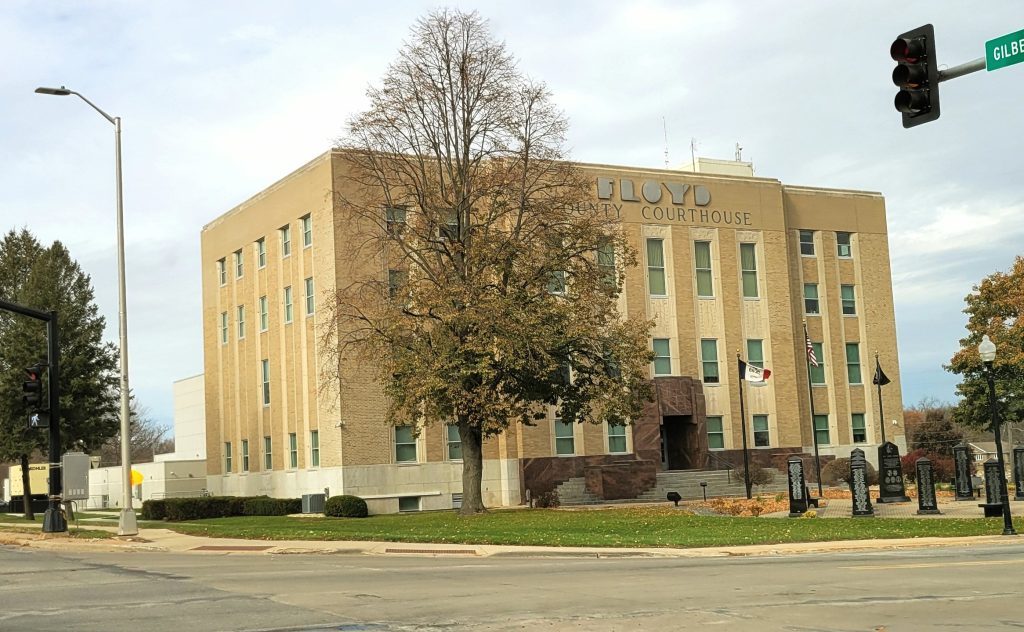
CHARLES CITY – The following are the expenses paid by Floyd county and Board of Supervisor meeting minutes for the period ending on April 24, 2024:
SUPERVISORS CURRENTLY SERVING:
Mark Kuhn
County Supervisor, District 1
Dennis Keifer
County Supervisor, District 2
Jim Jorgensen
County Supervisor District 3
Floyd County Board of Supervisors and Zoning Commission Joint Meeting
February 24, 2024, 1:30 p.m.
The Floyd County Board of Supervisors and Zoning Commission met at the EOC/Training Room at the Floyd County Courthouse with the following in attendance: Board of Supervisors Mark Kuhn, Dennis Keifer, and Jim Jorgensen and Zoning Commissioners Dean Tjaden, Ben Rottinghaus, and Guy Carpenter.
Supv Kuhn opened the meeting for the Board of Supervisors and Zoning Commissioners. Keifer/Jorgensen moved to approve the agenda. Motion carried 3-0.
John Robbins, North Iowa Area Council of Governments Senior Planner, introduced local representatives: County Conservation Director Adam Sears, Emergency Management Coordinator Jason Webster, North Iowa Regional Airport Manager Bill Kyle, and County Engineer Jacob Page. Presenters will provide information on wind energy system elements and concerns each deems relevant to the amendment of the county zoning ordinance.
Page will require a road use agreement for applicants. The agreement would require identified haul routes, video of condition of roads prior to and after the project completion to assess damages that need repaired, applicant pays for structural studies on bridges, gravel intersections are widened for turns and then returned back to normal width, and driveway permits would be applied for in the engineer’s office. Robbins added minimums for dust control during construction phase should be required, as well as oversize permits per State requirements, and conditional use or zoning permits pending the ordinance. Robbins said it is typical for the developer to propose construction routes and Page will access plans and suggest modifications. Jorgensen questioned why the county wouldn’t keep the roads widened rather than returning them to the normal width after the project is completed as it seems the wider roads would also accommodate today’s larger equipment. Page responded the wider intersections would be more costly to maintain in perpetuity and potentially changes drainage through intersections, requiring culvert extensions.
Webster suggested wind energy companies conduct training for emergencies for first responders every couple of years, supply equipment for rescues for all fire departments for quicker response time, provide emergency operation plans to fire departments, and require 911 addressing at tower locations. Turbine locations should consider line of sight obstructions between communications towers so as to not affect signal strength. Robbins mentioned FCC requires review for potential signal interference. On battery storage topic, Webster mentioned batteries, whether in cars or energy storage, are becoming more popular and are tough to mitigate from a fire department standpoint. Isaac Lamppa, Invenergy representative, mentioned batteries are typically lithium ion but there is new technology coming out. Tom Treharne, Nextera representative, mentioned battery storage units are designed to be self-containing and, in an event, the systems respond by removing all oxygen, letting the container mediate the issue. Both Nextera and Invenergy have emergency plans and provide training to responders. Lamppa will provide Robbins with sample response plans.
Kyle mentioned it is a common misconception that the FAA notice of hazards/damages protects airspace under 3,000 feet; the only way to protect this airspace of the local airport is with a local ordinance. Kyle is concerned about instrument approaches around the airport and is adamantly opposed to airport detection light systems (ADLS). If an airplane has a total electrical failure, ADLS on turbines will not turn on which could cause the airplane to fly into a turbine; some say the lights in the airport wouldn’t turn on because they are radio controlled but they can be with a cell phone call to turn the lights on. Kyle believes turbines should be lit 100% of the time from dusk to dawn, prefers all blink at the same time or all wouldn’t need to be lit if certain ones flashed at the same time. Anything more than 50 feet tall, such as meteorological towers, should also be lit, anything within a 5-mile radius with 50 feet or more in height should have approval by the airport authority, and anything outside the 5-mile radius should require a review by the county. Robbins suggested a cone overlay map, which is available at the airport, could be used for preliminary review. Robbins also mentioned the FAA requires high visibility markings on guide wires for over 200 feet; Kyle would like to see strobes on top of the lines. Lamppa mentioned Invenergy’s standard practice is to light towers the least amount of time possible; FAA determines which turbines need to be lit. Lamppa offered sending information on how ADLS signals work.
Sears expressed concerns for any type of habitat and protection of wildlife, including birds, bats, and insects in the air. River systems are highly used by migratory birds and wooded areas along rivers are natural perches for different species. Sears would like to see a natural fence line used instead of driveways in the middle of an area so as to not fragment habitat areas. Birds of prey have a downward look when hunting and can be struck by moving turbine blades. Sears has a different position than Kyle regarding lights as the light attracts wildlife and suggested upside-down hoods that can be installed underneath the lights. Campers would not want turbines close to campgrounds. Ag production areas, such as open fields, would be less attractive to wildlife than conservation areas; where there are two conservation areas a couple of miles apart would not be a good place for a turbine. The Department of Natural Resources offers recommendations, not regulations, on setbacks from the wildlife areas. Staying away from migratory areas, away from wetlands, protection from bald eagle sites, and limiting collision risks should be considered for setbacks. Robbins questioned if the Conservation Director or Conservation Board should have project information prior to a formal review process; Sears responded that during the review process should be sufficient. Robbins mentioned the US Fish and Wildlife Agency has a lot of considerations; Sears is fine with federal regulations but would want to consider state and local specific threats to migratory paths.
Tjaden suggested the wind farms provide an opportunity of revenue to the county to offset costs of supplies, repairs, and inflation and questioned what that revenue might be. Brandi Schmidt, Assessor, responded with information on the 2007 county ordinance that values turbines based on net acquisition cost from 0 to 30% of the cost phased in over a 7-year period. MidAmerican Energy turbines are fully phased in and generated about $975,000 in taxes in FY24. In working with Lamppa, Invenergy anticipates their acquisition cost to be $275 million and based on 30-50 turbines, using 2022 levy rates and the phase in period, the first year would generate about $300,000 in tax revenue and about $1.8 million by the seventh year and thereafter. Should the Board repeal that existing ordinance, the turbines would generate $1.8 million/year. All is subject to location of turbines in the county, levy rates in that jurisdiction, legislation that would come into play, assessment limitations and rollbacks. Ray Armel, Chickasaw County Land Use Administrator, mentioned their county’s new 66 turbines is expected to bring in $2 million in revenue per year. New legislation that capped allowable growth in valuations does not cap growth on new construction projects.
The Boards recessed at 2:33 p.m. and reconvened at 2:45 p.m.
Robbins introduced Kossuth County Engineer/Zoning Administrator Doug Miller, Chickasaw County Land Use Administrator Ray Armel, Clinton County Planning and Zoning Director Thomas Barnes, and Boone County Planning and Development Director Mike Salati.
Robbins explained methods per Iowa legislation to address wind energy systems: 1) Boone County uses conditional use permits, otherwise known as special use or special exception permits, that are more traditional and allow conditions in the permit, requiring a public hearing and approval by Board of Adjustments; 2) Clinton County developed a renewable energy district that goes through a rezoning process through the Zoning Commission following an assessment and advisory phase and then to the Board of Supervisors for final approval; 3) Kossuth County created a separate ordinance that requires a special type of permit process and is approved by the Board of Supervisors; 4) Chickasaw County has land use regulations with an ordinance that goes through the Board of Supervisors.
Miller shared Kossuth’s process with two initial small turbine projects approved by a special use permits per a county ordinance. In 2016, three developers requested 250 mw wind farms which the county’s ordinance could not handle the size of the project. Planning & Zoning worked on a comprehensive plan and a new ordinance with the purpose to provide the process of a large-scale wind energy conversion system requiring the Board of Supervisor to oversee the permitting process that was put in place in 2017. The ordinance was amended in 2019 to modify setbacks, add first in right language, increase height to 600 feet, and limited up to 700 mw systems. The ordinance was amended again in 2020 with changes to help the permitting process. Miller emphasized a good GIS system is important for planning, construction and to map areas of agreements. Kossuth County has good staff in the engineer’s office to watch roads per the road agreements. Miller believes their ordinance works well and accomplishes what it was intended to do.
Armel commented that Chickasaw County gathered about 10-20 different ordinance to put together an ordinance to establish minimum standards and that allows the landowner to decide if they wanted to go stricter. Construction started on Invenergy’s project prior to the ordinance so a separate agreement was put in place that followed the basic guidelines of the ordinance. Invenergy’s project went online in September and there have been no complaints on noise or flicker. Some concerns during construction were dust on roads, speed traveled on roads, and not using primary haul routes. If they were to do it over, they would likely create greater setbacks. Shape files of easement areas, driveways and turbines were provided to put on GIS mapping system. The Planning commission has been dissolved and processes are under the direction of the supervisors.
Barnes provided information on Clinton County’s wind ordinance put place in 2008 and solar ordinance put in place in 2016. A 1600-acre solar project started with the county not being aware of landowners signing agreements. Applications were originally approved by the Board of Adjustments but due to the scale of the solar projects it was later decided it was too big of a decision for five volunteers to oversee. In 2020-2021 the solar ordinance was updated with 32 conditions. There has been lots of opposition to wind turbines especially with Nextera applying for met towers and social media posts claiming wind turbines will be next. The county is looking to update its wind energy ordinance.
Salati mentioned the traditional regulations of a conditional use application process with the Board of Adjustments has worked out well for Boone County. The ordinance adopted in 2008 set the basic framework, not overly regulated, but maybe not even effectively regulated. Things learned in a MidAmerican Energy project in 2013 were watched out for with a Apex project in 2019. The permitting process was quite smooth after problems that had to do with road use compliance and drainage district tile lines broken were resolved. Salati sees benefits of ADLS introduced with the Apex project. A landowner sued the county and MidAmerican over aesthetic issues of seeing turbines which MidAmerican was able to settle and ended up moving a second planned project out of the county. Other concerns brought up during development were in regard to tax abatements and taking high productive farms out of production, but the concerns didn’t create a detrimental effect in the county. Boone County is working on a solar ordinance now. Some landowners have signed solar project contracts.
Presenters were thanked for sharing their information.
Robbins is working on a draft of the ordinance. The Zoning Commission would like to have a workshop with Robbins before having their public hearing. The moratorium is in effect through May 20 but that could be extended.
With no further discussion, the meeting for the Zoning Commission was adjourned.
Jorgensen/Keifer moved to adjourn the meeting. Motion carried 3-0.
ATTEST:
Gloria A. Carr Mark A. Kuhn, Chair
Floyd County Auditor Floyd County Board of Supervisors
Floyd County Board of Supervisors Meeting
May 2, 2024, 9:00 a.m.
The Floyd County Board of Supervisors met at Floyd County Courthouse Board Room with the following in attendance: Supv Mark Kuhn, Supv Dennis Keifer and Supv Jim Jorgensen.
Jorgensen/Keifer moved to approve the agenda as presented. Motion carried 3-0.
Joe Hull, Hot Shots Billiards owner, presented information for a liquor license permit for an event on Saturday at Clover Ridge. The permit was erroneously filed with the City of Charles City as jurisdiction but should have been filed with Floyd County as jurisdiction. On Monday, the Iowa Alcoholic Beverage Division informed Auditor Carr of the issue. Auditor Carr reported that all paperwork is in order. Keifer/Jorgensen moved to approve a liquor license application for Hot Shots Billiards for an event this weekend at Clover Ridge, 2526 US 218, Charles City. Motion carried 3-0.
Keifer/Jorgensen moved to adjourn. Motion carried 3-0.
ATTEST:
Gloria A. Carr Mark A. Kuhn, Chair
Floyd County Auditor Floyd County Board of Supervisors