


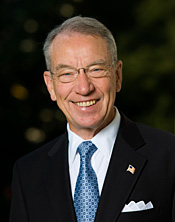
 From Senator Charles Grassley –
Recently, the Congressional Budget Office released an update to its report on average effective tax rates. Several of my colleagues on the other side of the aisle have pounced on this report to claim that tax rates are at historical lows.
Just this morning, in a floor speech the Majority Leader said the lowest tax rate in 30 years was “thanks to President Obama, who has consistently fought to lower taxes for the middle-class families over the last three and half years.”
However, the Majority leader and others in his party are only telling you half the story. The report also shows that incomes of households in all income groups have declined by an average of 12 percent since 2007. This means that Americans are 12 percent poorer than they were in 2007.
Should we thank President Obama for this reduction in income?
Essentially, this is what the Majority Leader is doing when he thanks President Obama for lower tax rates. When individuals have less income, they pay less in tax. Millions of Americans are out of work and have no or very little income. You would have better luck getting blood out of a turnip than collecting income taxes from someone who has no income.
Over the past weeks and months we have heard a lot about income inequality. The Occupy Wall Street crowd has been very vocal on this issue. Many members of Congress have also expressed concerns that income inequality is ever increasing. The Finance Committee, of which I am a member, just recently had a hearing on this topic.
This most recent CBO data shows that income inequality is at its lowest point in more than a decade. The share of income held by the top 1 percent has shrunk by 28 percent.
At the same time, the bottom 60 percent of households saw their share of income increase by an average of 11 percent. So, perhaps, my friends on the other side of the aisle do have a reason to cheer. The rich are less rich, but of course, the poor are poorer too. It’s just that those with lower incomes did not see their income shrink by as much.
Of course, those in the bottom 60 percent of households are not better off today than they were when income inequality was greater. In fact, they are poorer, and struggling more than ever.
I would just hope my colleagues on the other side of the aisle keep that in mind as we try to create a better future for everyone. Reduction in income inequality should not be a goal in of itself. What matters is individual well-being and opportunity to succeed.
This is best achieved through pro-growth policies aimed at growing the economic pie, not by targeting certain unpopular groups for tax hikes.
4 thoughts on “Grassley: Americans are 12 percent poorer than they were in 2007”
You know he must be doing something right as he keeps getting re-elected. We need to clean house in all of Washington starting with our socialist president.
He keeps getting re-elected because people don’t bother to read up on the candidates. They vote for him because he’s a familiar name and that makes them feel comfortable with their vote. They want to go with a “winner”, when, in truth, he’s one big loser who votes against access to healthcare and anything to do with women.
How’s everything working out for YOU, Sen. Grassley? Are YOU 12% poorer? How about 12% WEALTHIER?!? Is that more like it? Are you enjoying all the perks you receive at the expense of people like me? I’ll bet it’s a great feeling knowing your healthcare is covered 100% and you never, ever have to worry for the rest of your life about money because we taxpayers are taking very good care of you and will continue to do so long after you retire (which can’t be soon enough).
And Grassely is 1,000% richer since he entered public life.