

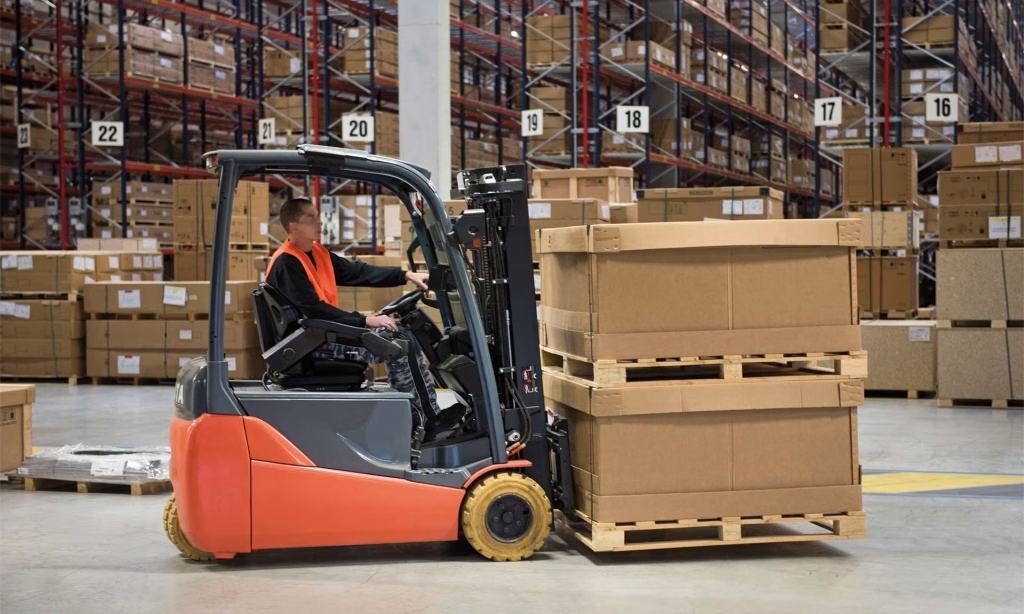
Distribution centers operate on tight margins and tighter schedules. Every delay, every product rejection, and every compliance issue ripples through the operation in ways that are difficult to absorb. One of the more persistent and underestimated contributors to those disruptions is pallet condition. Damaged, contaminated, or structurally compromised pallets create downstream problems that go well beyond a single shipment — they affect sorting accuracy, storage density, load stability, and in regulated industries, they can trigger audits or product holds.
Building a formal pallet management program is not a one-time fix. It is an ongoing operational discipline. Distribution centers that treat pallet quality as a managed function — rather than an afterthought — consistently see improvements in product integrity, labor efficiency, and inbound-outbound flow. This guide outlines the steps involved in establishing that kind of program from the ground up, with particular attention to how each phase connects to real operational outcomes.
Understanding What a Clean Pallet Standard Actually Means in Practice
The term clean pallets is used frequently in distribution and logistics contexts, but it carries different meanings depending on the industry, the customer, and the product type. In food and beverage distribution, cleanliness refers to sanitary condition — freedom from contamination, pests, chemical residue, and structural damage that could compromise product contact surfaces. In pharmaceutical or healthcare supply chains, the standard often includes documentation of material origin and surface treatment history. In general retail or industrial distribution, cleanliness may primarily mean structural integrity and dimensional consistency.
Understanding clean pallets as a concept means recognizing that the word “clean” covers at least two separate dimensions: physical condition and compliance suitability. A pallet that looks intact may still carry contamination risk. A pallet that passes a visual check may be structurally weakened in ways that only show under load. Building a program that accounts for both dimensions requires deliberate inspection protocols and clear classification systems.
Why Classification Matters Before Inspection Can Work
Many distribution centers attempt to run pallet inspection processes without first defining what categories of condition they are sorting for. This creates inconsistency. When inspectors work without a clear classification system, they make judgment calls that differ from shift to shift, person to person, and that inconsistency becomes embedded in the operation. One team accepts a pallet that another team would reject, and the downstream consequence is that product managers, carriers, and customers receive different quality outputs depending on timing.
A working classification system typically divides pallets into at minimum three condition categories: ready for immediate use, requires repair before use, and retired from circulation. Each category should have defined criteria — not subjective descriptions, but observable characteristics that any trained team member can identify without interpretation. When that foundation is in place, inspection becomes a sorting function rather than a decision-making burden.
Establishing an Inbound Inspection Gate
The most effective point of control in a pallet program is the moment of receipt. Pallets that arrive damaged, contaminated, or non-compliant are far easier to reject at the dock than to manage once they have entered the building and moved through the distribution flow. An inbound inspection gate is a designated process — not necessarily a physical structure — where incoming pallets are assessed before they are accepted into the facility’s usable inventory.
This gate function is often absorbed into the general receiving process, but there is a meaningful operational difference between a receiving team that checks for box counts and a receiving team that is also accountable for pallet condition. Combining both responsibilities without role clarity or dedicated time tends to result in pallet inspection being skipped during high-volume periods, which is precisely when the risk of accepting compromised materials is highest.
Integrating Pallet Review Into Receiving Workflows Without Slowing Throughput
The concern most operations managers raise when formalizing inbound inspection is throughput. Adding a step to receiving slows the dock, and dock slowdowns create congestion that can cascade through the entire facility schedule. This concern is legitimate, but it is usually a design problem rather than a capacity problem. When pallet inspection is designed as a parallel activity — running alongside unloading rather than sequentially after it — the throughput impact is significantly reduced.
Assigning a dedicated receiver whose primary responsibility is pallet condition review, rather than adding that responsibility to a team member already managing product verification, allows the dock to maintain pace while capturing condition data. The inspection result feeds directly into whether pallets are accepted, quarantined, or returned, and that decision becomes part of the receiving record rather than an informal verbal handoff that disappears after the truck leaves.
Building a Repair and Recirculation System
Not every pallet that fails initial inspection should be discarded. In high-volume operations, a meaningful portion of incoming pallets that do not meet immediate-use standards can be restored to serviceable condition through minor repair. Boards can be replaced, fasteners reinforced, and surface contamination removed when the structural integrity underneath is sound. The question for any distribution center is whether the volume and frequency of pallet repair justifies maintaining that capability in-house or routing through an external service.
What determines that decision is not repair complexity alone — it is repair volume consistency. An operation that receives a steady, predictable flow of repairable pallets can often justify an in-house repair station with trained personnel and basic equipment. An operation with highly variable inbound pallet condition, or one where repair volume spikes unpredictably, typically finds that in-house repair creates labor inefficiency during low-volume periods and bottlenecks during high-volume ones.
Tracking Pallets Through the Repair Cycle to Prevent Recirculation of Substandard Units
One of the failure modes that undermines otherwise well-designed pallet programs is the recirculation of pallets that passed through a repair process but were not fully restored to standard. This happens when repair activity is logged informally or not tracked at all. A pallet moves from the inspection hold area to the repair station, and from there directly back into the usable pool — sometimes without a secondary verification step confirming that the repair brought it to the required condition level.
Preventing this requires a simple but consistently enforced process: repaired pallets must pass a post-repair condition check before re-entering circulation, and that check must be documented separately from the repair record. The separation of repair and verification — ideally with different personnel responsible for each — creates an accountability structure that keeps substandard units out of the active pool without requiring complex systems to manage it.
Coordinating Pallet Standards Across Inbound and Outbound Flows
A common structural gap in distribution center pallet programs is the disconnect between inbound and outbound standards. Inbound teams focus on what they receive from suppliers. Outbound teams focus on what they send to customers or retail partners. In many operations, these two groups work from different assumptions about what an acceptable pallet looks like, and the facility absorbs the inconsistency between them.
The National Institute of Standards and Technology has long emphasized that operational consistency across a facility — not just within individual departments — is what determines whether quality management systems produce reliable outcomes. The same principle applies to pallet standards. A unified standard that applies equally to what is accepted inbound and what is dispatched outbound closes the gap that allows compromised materials to cycle through a facility undetected.
Communicating Pallet Requirements to Carriers and Suppliers
Consistency within the distribution center does not fully solve the problem if the organizations delivering and receiving pallets operate under different expectations. Suppliers who do not know that a facility has adopted specific pallet condition requirements will continue to deliver on whatever standard they are accustomed to using. Carriers who handle returns or pool exchanges may apply their own condition criteria that differ from the facility’s internal standard.
Addressing this requires written pallet requirements to be included in supplier agreements and carrier contracts — not as a footnote, but as a documented expectation with defined consequences for non-compliance. Facilities that communicate these requirements clearly and consistently find that inbound rejection rates decrease over time, because their supply partners adapt to the standard rather than testing it. The upfront work of communicating requirements reduces the ongoing labor of managing exceptions.
Maintaining Program Discipline Over Time
Pallet programs are straightforward to launch and difficult to sustain. The initial momentum of a new process tends to produce early improvements in pallet condition across the facility, but without ongoing structure, those improvements erode. Staff turnover means new team members are trained inconsistently. High-volume periods create pressure to skip inspection steps. Suppliers learn quickly when enforcement is inconsistent and gradually return to previous behaviors.
The operations that maintain program discipline are those that treat pallet condition as a tracked metric rather than a managed impression. When condition data is collected, reviewed, and acted upon on a regular cycle — weekly or monthly depending on volume — the program has an internal feedback mechanism. Rejection rates, repair volumes, and supplier performance data make visible what is working and what is not, and that visibility creates the accountability structure that sustains the program between audits and management reviews.
Reviewing Standards as Operational Conditions Change
A pallet standard that works well for one product mix or one set of customers may not transfer cleanly when the operation changes. New product categories with different weight profiles, new retail partners with tighter compliance requirements, or changes in storage configuration can all affect what a clean pallet needs to be. Treating the program’s standards as fixed once established is itself a risk, because the standard may quietly fall out of alignment with actual operational needs while continuing to pass formal reviews.
Scheduling a formal standard review on a defined cycle — separate from daily or weekly condition tracking — allows the program to adapt without requiring a full redesign. The review asks whether the current classification criteria still match what the operation actually needs from its pallets, and whether the inspection and repair processes are still calibrated to catch the failure modes that matter most to current customers and product requirements.
Conclusion
Building a clean pallet program for a distribution center is not a complex undertaking, but it is a disciplined one. The challenge is rarely technical — it is organizational. Clear standards, consistent inspection, documented repair processes, unified inbound and outbound expectations, and regular performance review are the elements that make a program function reliably over time rather than just at launch.
The operational payoff is not primarily about pallets themselves. It is about the downstream stability that comes from removing a variable that has historically introduced unpredictability into product handling, storage, and dispatch. Distribution centers that manage pallet condition as a formal function reduce the number of reactive decisions their teams have to make — and that reduction compounds over time into measurable gains in efficiency, reliability, and customer consistency.