



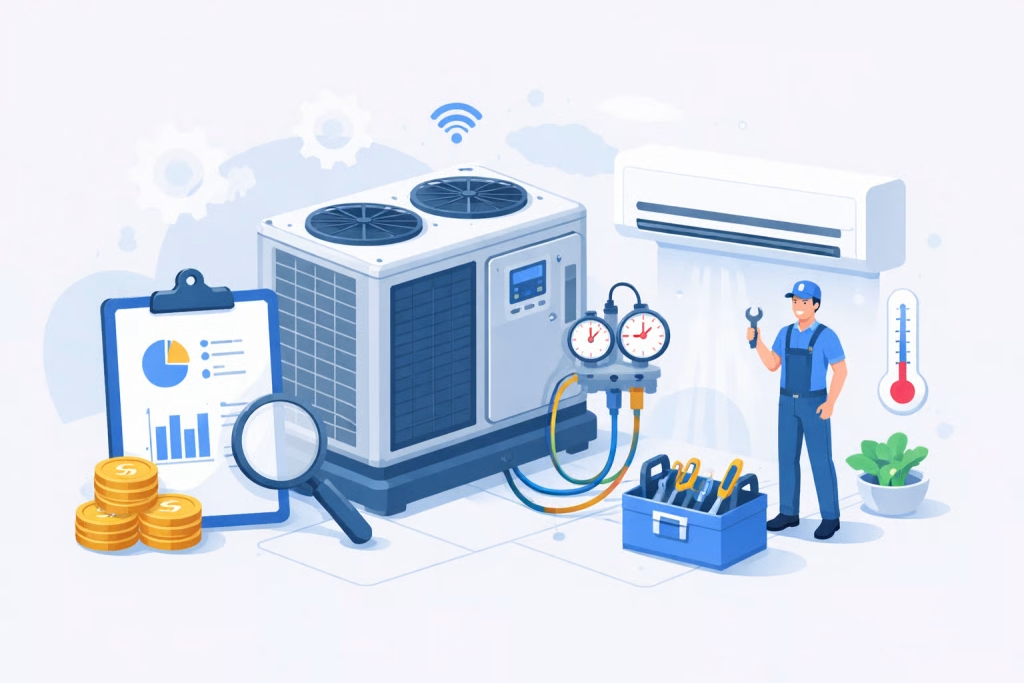
Heating and cooling are easy to take for granted until something stops working. A failed air conditioner in the middle of summer or a broken heating system during winter quickly turns HVAC from an invisible part of a building into an urgent priority.
That reliability of demand is one reason the HVAC industry has become such an important part of the wider construction, property and building-services economy. But the industry is not simply growing because more people need heating and cooling. Changes in technology, construction, energy efficiency and consumer expectations are all reshaping the market.
For contractors, manufacturers and service businesses, understanding where the industry is heading can be just as important as understanding where it is today.
A Large Industry With Multiple Revenue Streams
The HVAC market is much broader than residential air conditioning.
It includes equipment manufacturing, installation, replacement, maintenance, repairs, commercial systems, industrial applications, ventilation and an increasingly wide range of smart and energy-efficient technologies.
That diversity gives the industry a significant advantage. Demand does not come from one customer type or one product category.
A homeowner may need a new air conditioning system. A property manager may need preventative maintenance across dozens of buildings. A commercial facility may require a completely different heating, cooling or ventilation solution.
Each represents a different commercial opportunity.
Recent estimates also demonstrate just how substantial the market has become. For a detailed breakdown of the HVAC industry market size, growth projections and the factors driving the market, see this HVAC industry market size analysis.
Replacement Demand Keeps the Market Moving
One of the most important characteristics of HVAC is that equipment has a finite useful life.
Even when a building owner doesn’t want to spend money replacing an ageing system, eventually repairs become less economical, efficiency declines or the equipment fails completely.
That creates a replacement cycle that supports demand for HVAC contractors and manufacturers.
New construction adds another layer of demand. Every new home, office, retail property, warehouse, school or industrial facility requires appropriate heating, ventilation and cooling infrastructure.
In other words, the market isn’t dependent solely on people deciding they want better equipment. Much of the demand is built into the physical infrastructure of buildings.
Energy Efficiency Is Becoming a Commercial Driver
Energy costs are another major factor influencing HVAC purchasing decisions.
An inefficient system can consume significant amounts of energy over its operating life. Consequently, customers increasingly have reasons to consider efficiency alongside the upfront purchase price.
This is particularly relevant for commercial properties.
For a large building operating HVAC equipment for long periods, even relatively modest efficiency improvements can have meaningful financial implications. Facility managers therefore have an incentive to look beyond simply replacing failed equipment with the cheapest available option.
This is creating opportunities around high-efficiency systems, heat pumps, advanced controls and building-management technology.
For HVAC businesses, that means technical knowledge is becoming increasingly valuable. Contractors who can explain operating costs and efficiency rather than simply quoting an installation price can position themselves as problem-solvers rather than commodity installers.
Technology Is Changing What an HVAC System Can Do
The modern HVAC system can be considerably more sophisticated than the equipment installed in previous generations of buildings.
Smart thermostats, connected controls, sensors and automated building-management systems allow equipment to be monitored and adjusted in ways that were previously difficult or impossible.
For businesses, this creates another potential revenue stream: ongoing service and optimisation.
Instead of viewing installation as the end of the customer relationship, HVAC companies can build longer-term relationships around maintenance, monitoring and system performance.
That matters commercially because recurring service revenue can make a business less dependent on constantly finding new installation projects.
Commercial HVAC Creates Significant Opportunities
Residential customers are an important part of the HVAC economy, but commercial work introduces a different set of opportunities.
Office buildings, hotels, restaurants, hospitals, warehouses, factories and retail locations can have complex heating and cooling requirements.
A commercial customer may also have substantially greater lifetime value than a one-off residential customer because the relationship can involve preventative maintenance contracts, emergency repairs, equipment replacement and additional locations.
The trade-off is that commercial HVAC generally requires greater expertise, more sophisticated equipment and the ability to handle larger projects.
For companies willing to build that capability, however, it can create a powerful growth path.
Maintenance Is More Than an Afterthought
Equipment installation tends to receive the most attention because it involves a visible, high-value transaction.
Maintenance is arguably just as important from a business perspective.
HVAC systems require ongoing attention to operate effectively. Filters, coils, electrical components, refrigerant systems, controls and other components can all require inspection or servicing.
For building owners, preventative maintenance can help identify problems before they turn into expensive failures.
For HVAC businesses, maintenance creates something even more valuable: recurring customer relationships.
A contractor that installs a system and disappears has to compete for the customer’s next project. A contractor that provides reliable maintenance has a reason to remain involved throughout the life of that system.
That creates opportunities for cross-selling, replacement planning and emergency service.
The Labour Market Matters Too
A growing HVAC market needs people capable of designing, installing, repairing and maintaining the systems involved.
That makes the availability of skilled technicians a significant issue for the industry.
Businesses may have demand for work but still struggle to complete projects if they cannot recruit and retain enough qualified employees.
This puts pressure on HVAC companies to think beyond customer acquisition.
Training, apprenticeships, retention and career progression can become competitive advantages. Companies that develop technicians internally may have more control over their future capacity than businesses relying entirely on an external labour pool.
The result is an industry where workforce strategy and marketing strategy increasingly overlap.
There is little point generating more leads if the company cannot service them.
What This Means for HVAC Businesses
The expanding HVAC market creates opportunities, but growth isn’t automatic.
Companies still need to differentiate themselves, generate qualified leads, control acquisition costs and deliver a strong customer experience.
For contractors, one of the biggest opportunities is moving away from competing purely on price.
A business that specialises in a particular type of customer, equipment or problem can potentially build stronger positioning than a generic HVAC company offering everything to everyone.
That positioning can also make digital marketing more effective because the company has clearer topics, services and customer problems to target.
Content can then support the entire buying journey: explaining equipment, comparing technologies, answering maintenance questions, addressing replacement decisions and helping commercial property owners understand their options.
Looking Beyond the Next Service Call
The HVAC industry has several structural characteristics that make it commercially interesting: essential services, ageing equipment, replacement cycles, new construction, recurring maintenance and technological change.
Those factors create demand across multiple parts of the market rather than concentrating opportunity in a single product.
For HVAC businesses, the challenge is turning that underlying market demand into profitable growth.
That means understanding the market, choosing the right customer segments, building the right service mix and developing a reliable acquisition system.
The companies that do that well won’t simply benefit from a larger HVAC industry. They’ll be positioned to capture a larger share of the demand that already exists.
And with technology, energy efficiency and building requirements continuing to evolve, HVAC is likely to remain an industry where technical expertise and commercial execution matter in equal measure.